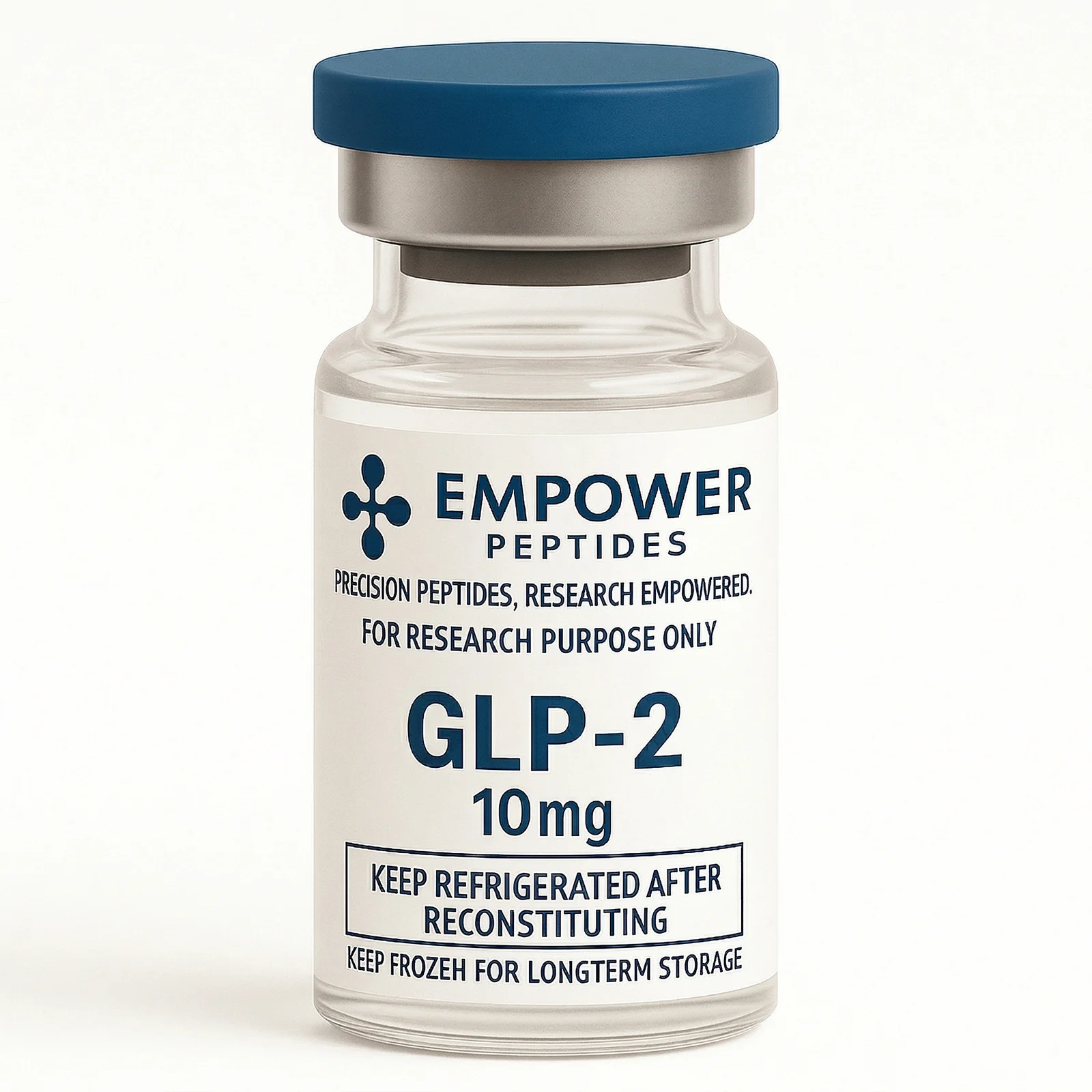


GLP-2 Research Grade Metabolic Peptide | Intestinal Repair & Gut Health Compound
Research Use Only — GLP-2 is intended exclusively for in vitro and preclinical research. Not for human or veterinary consumption.
GLP-2 (Glucagon-Like Peptide-2) is a research-grade metabolic peptide studied for its role in intestinal repair, epithelial barrier integrity, mucosal adaptation, nutrient absorption, and gut-health signaling pathways. As an intestinotrophic peptide derived from the proglucagon system, GLP-2 has become a significant compound in gastrointestinal biology, metabolic research, and intestinal regeneration models.
Unlike broad “gut health” compounds that are often discussed in vague wellness terms, GLP-2 occupies a much more specific research lane: the study of intestinal epithelial renewal, crypt-villus architecture, GLP-2 receptor signaling, intestinal permeability, and mucosal barrier restoration. That specificity is exactly why it has attracted attention in preclinical models involving short bowel adaptation, enteritis, colitis, malabsorption, and intestinal injury repair.
What Is GLP-2?
GLP-2 — short for Glucagon-Like Peptide-2 — is a 33-amino acid peptide hormone produced through tissue-specific processing of proglucagon, primarily associated with enteroendocrine L cells in the distal small intestine and colon. In research settings, GLP-2 is studied as a key regulator of intestinal growth, epithelial survival, digestion, absorption, and gut barrier function.
Its biological interest comes from the way it appears to coordinate multiple intestinal repair processes at once. GLP-2 does not simply “support the gut” in a generic sense. In controlled models, it is investigated for effects on crypt cell proliferation, villus height, epithelial apoptosis, tight junction integrity, mesenteric blood flow, nutrient transporter activity, and intestinal mucosal surface area.
GLP-2 research also intersects with the clinical development history of GLP-2 analogs such as teduglutide, a modified GLP-2 receptor agonist approved for specific short bowel syndrome contexts. However, native GLP-2 supplied for laboratory investigation remains a research compound only and is not a therapeutic drug, supplement, or consumer product.
Mechanisms Under Investigation
GLP-2 is studied across several interconnected mechanisms in intestinal biology. These pathways help researchers evaluate how epithelial repair, gut barrier protection, and metabolic signaling may converge within the gastrointestinal tract.
GLP-2 Receptor Signaling
GLP-2 is investigated through the GLP-2 receptor, commonly referred to as GLP-2R. This receptor is central to studies examining intestinal growth, epithelial repair, enteric nervous system signaling, and paracrine communication between epithelial, neuronal, and stromal cell populations.
Crypt Cell Proliferation and Villus Architecture
One of the most studied GLP-2 pathways involves intestinal epithelial renewal. Research models evaluate GLP-2 for effects on crypt cell proliferation, villus height, mucosal surface area, and structural adaptation following intestinal stress or resection-based models.
Intestinal Barrier Function
GLP-2 is frequently examined in models of intestinal permeability and epithelial barrier disruption. Key research endpoints include tight junction regulation, paracellular permeability, epithelial resistance, mucosal inflammation, and barrier recovery after experimentally induced injury.
Anti-Apoptotic and Cytoprotective Activity
GLP-2 research includes evaluation of epithelial cell survival, reduced apoptosis, and mucosal cytoprotection. These mechanisms are especially relevant in preclinical models involving enteritis, colitis, ischemic stress, chemotherapy-associated intestinal injury, and inflammatory barrier disruption.
Digestion, Absorption, and Intestinal Blood Flow
GLP-2 is also studied for its relationship to nutrient absorption, digestive capacity, intestinal blood flow, and post-prandial metabolic signaling. This makes it relevant not only to epithelial repair research but also to broader metabolic studies involving intestinal adaptation and nutrient handling.
Research Applications and Study Models
GLP-2 has relevance across gastrointestinal, metabolic, inflammatory, and regenerative research. Below are the main investigative contexts where GLP-2 is commonly studied.
Mucosal Growth and Epithelial Renewal
Crypt-villus remodeling, epithelial proliferation, mucosal surface expansion, intestinal adaptation, epithelial survival, and repair following experimentally induced gut injury.
Permeability and Tight Junction Research
Models examining intestinal permeability, epithelial resistance, tight junction proteins, paracellular transport, endotoxin translocation, and mucosal barrier recovery.
Intestinal Adaptation Research
Preclinical resection models, absorptive capacity studies, mucosal adaptation, intestinal failure modeling, villus height changes, and nutrient uptake dynamics.
Colitis, Enteritis, and Mucosal Stress
DSS colitis models, chemotherapy-associated intestinal injury, inflammatory cytokine signaling, epithelial apoptosis, mucosal lesion scoring, and repair-phase biology.
Absorption, Lipid Handling, and Energy Balance
Nutrient absorption studies, intestinal lipid trafficking, post-prandial gut signaling, digestive enzyme activity, intestinal blood flow, and epithelial transport systems.
Learn More: BPC-157 | Research Grade Body Protection Peptide for Cellular Repair & Healing
Experimental Formats in GLP-2 Research
GLP-2 is used across multiple laboratory formats depending on the research question, biological model, and endpoint being measured. Experimental design should always be handled by qualified investigators using approved institutional protocols.
- In Vitro Epithelial Models — Used to study epithelial barrier integrity, tight junction behavior, permeability markers, and cellular response pathways under controlled conditions.
- Intestinal Organoid Systems — Applied in advanced mucosal biology research to evaluate epithelial differentiation, crypt-like structures, growth patterns, and receptor-mediated signaling.
- Preclinical Gut Injury Models — Used to study mucosal repair, inflammatory barrier disruption, intestinal adaptation, epithelial apoptosis, and recovery after experimental injury.
- Metabolic Absorption Studies — Relevant to nutrient uptake, lipid handling, digestive function, intestinal blood flow, and gut-derived endocrine signaling.
Research-Grade GLP-2 from Empower Peptides
Empower Peptides supplies GLP-2 for qualified laboratory, academic, and preclinical research applications. Every research peptide should be evaluated not only by catalog name, but by the quality controls behind it: identity confirmation, purity analysis, batch documentation, handling conditions, and consistency from vial to vial.
For GLP-2 studies, purity and identity are especially important because intestinal barrier, epithelial proliferation, and metabolic signaling endpoints can be sensitive to contaminants, degradation products, truncated sequences, or batch variability. In plain English: if the peptide is questionable, the data is questionable. Good research starts before the first assay.
| Catalog Name | GLP-2 |
| Full Name | Glucagon-Like Peptide-2 |
| Peptide Class | Metabolic / intestinotrophic gut peptide |
| Primary Research Focus | Intestinal repair, gut barrier function, mucosal adaptation, nutrient absorption, GLP-2R signaling |
| Formulation Type | Lyophilized powder |
| Purity Verification | HPLC-tested, mass spectrometry confirmed |
| Documentation | Batch-specific Certificate of Analysis (CoA) |
| Storage | Store according to laboratory peptide handling protocols; protect from excess heat, moisture, and repeated freeze-thaw cycles |
| Intended Use | In vitro and preclinical research only |
| Regulatory Status | Not for human or veterinary use |
Why GLP-2 Matters in Gut Health Research
GLP-2 sits at the intersection of several high-value research domains: gastrointestinal regeneration, epithelial barrier biology, metabolic peptide signaling, intestinal permeability, nutrient absorption, and inflammatory gut models. That makes it a strong compound of interest for researchers who need to examine the gut as a dynamic biological system rather than as a passive digestive tube.
In modern gastrointestinal research, “gut health” is not a slogan. It is a measurable framework involving epithelial turnover, mucosal immune tone, microbial interface integrity, tight junction behavior, digestive and absorptive capacity, and vascular support of the intestinal lining. GLP-2 is valuable because it touches many of these systems through mechanisms that can be tested, measured, and compared across experimental models.
For laboratories studying intestinal injury, malabsorption, short bowel adaptation, inflammatory bowel models, or epithelial repair kinetics, research-grade GLP-2 provides a targeted tool for investigating how the intestine responds to damage, adapts to stress, and restores barrier function.
Learn More: GLP-1 Research Grade Metabolic Peptide
Frequently Asked Questions — GLP-2 Peptide
What makes GLP-2 important in intestinal repair research?
GLP-2 is studied for its role in epithelial renewal, crypt cell proliferation, villus architecture, mucosal surface area, barrier function, and intestinal adaptation. These mechanisms make it especially relevant to preclinical models of gut injury, malabsorption, and mucosal repair.
How is GLP-2 different from GLP-1?
Both GLP-1 and GLP-2 are derived from the proglucagon system, but they are studied for different biological priorities. GLP-1 is widely associated with glucose regulation, insulin secretion, appetite, and metabolic disease research. GLP-2 is more specifically associated with intestinal growth, epithelial barrier integrity, gut repair, and absorptive function.
What is GLP-2R?
GLP-2R stands for glucagon-like peptide-2 receptor. It is the primary receptor pathway investigated in GLP-2 research and is central to studies involving epithelial growth, intestinal adaptation, enteric signaling, and mucosal repair responses.
Is GLP-2 the same as teduglutide?
No. GLP-2 refers to the native glucagon-like peptide-2 sequence used in research contexts. Teduglutide is a modified GLP-2 analog developed as a regulated therapeutic product for specific medical use cases. Research-grade GLP-2 from Empower Peptides is not teduglutide and is not intended for clinical, human, veterinary, or supplement use.
Why does purity matter when sourcing GLP-2?
GLP-2 research often involves sensitive endpoints such as epithelial permeability, cell proliferation, apoptotic signaling, inflammatory markers, and nutrient transport. Impurities, truncated peptides, or degradation products can distort experimental outcomes. Batch-specific purity and identity testing help protect the integrity of the research.
Is GLP-2 available from Empower Peptides for research institutions?
Yes. Empower Peptides supplies research-grade GLP-2 for qualified laboratories, academic institutions, and licensed investigators. Products are intended strictly for in vitro and preclinical research use.
Disclaimer: GLP-2 is manufactured and distributed by Empower Peptides exclusively for scientific and preclinical research purposes. This product has not been evaluated by the Food and Drug Administration (FDA) or equivalent regulatory authorities. It is not intended for human consumption, is not a therapeutic drug, and must not be used as a dietary supplement. All research must be conducted by qualified investigators in compliance with applicable institutional, national, and international regulatory guidelines.