

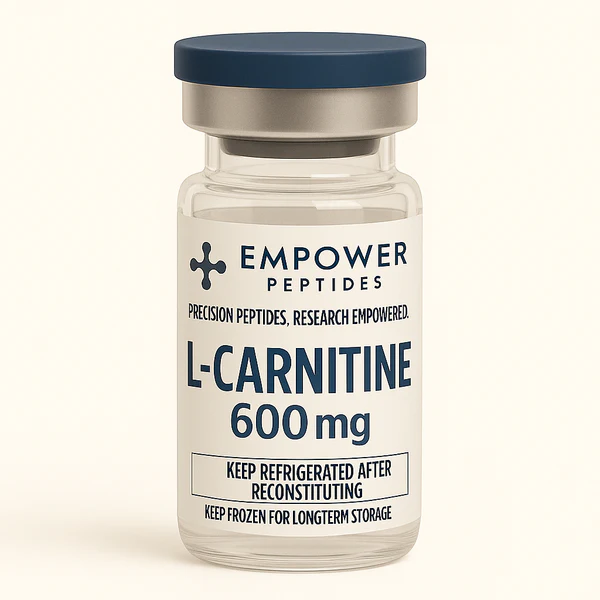

L-Carnitine – Amino Acid and Lipotropic Compound
Price range: $50.00 through $76.00
“`html
L-Carnitine – Research-Grade Aqueous Solution
L-Carnitine is a well-characterized research compound frequently utilized in laboratory studies involving cellular metabolism, mitochondrial function, and biochemical pathway investigations. Its defined molecular structure makes it a valuable tool for controlled experimental models evaluating cellular processes and pathway activity.
Aqueous solution supplied in laboratory vials.
Not for injection. Not for clinical, therapeutic, or diagnostic use.
📌 Product Specifications
- Active Ingredient: L-Carnitine
- CAS Number: 541-15-1
- Form: Clear, colorless to light-yellow aqueous solution
- Concentration Options: 1200 mg/mL (10 mL Vial) or 600 mg/mL (10 mL Vial)
- Storage: Store in a cool, dry environment. Refrigerate after opening.
🔬 Research Applications
- Mitochondrial function research
- Cellular metabolism pathway investigations
- Biochemical process and signaling studies
🧪 Molecular Details
- Molecular Formula: C7H15NO3
- Molecular Weight: 161.2 g/mol
- Form: Aqueous Solution
- Appearance: Clear, colorless to light-yellow solution
L-Carnitine – Frequently Asked Questions (Research Use Only)
This FAQ provides structured, research-focused information regarding L-Carnitine, a research-grade compound supplied as an aqueous solution for controlled laboratory environments.
1. What research purpose does L-Carnitine serve?
L-Carnitine is utilized in laboratory environments to investigate cellular metabolism, mitochondrial function, and biochemical pathway activity under controlled experimental conditions.
2. What makes L-Carnitine suitable for laboratory research?
Its well-characterized biochemical properties make L-Carnitine useful for studying mitochondrial function, cellular metabolism, and related laboratory research models.
3. Why is L-Carnitine supplied as an aqueous solution?
The aqueous solution format supports convenient laboratory handling, accurate measurement, and consistent preparation within controlled research environments.
4. What does the concentration variability indicate?
The available concentrations of 1200 mg/mL and 600 mg/mL allow researchers to select the format most appropriate for their experimental design. This flexibility supports a variety of laboratory research models and controlled experimental designs.
5. What key identifiers are associated with L-Carnitine?
L-Carnitine is defined by CAS Number 541-15-1, molecular formula C7H15NO3, and molecular weight 161.2 g/mol. These identifiers support accurate compound tracking, research documentation, and laboratory analysis.
6. Is L-Carnitine approved for human or animal use?
No. L-Carnitine is offered strictly as a research-use-only laboratory material. It is not for human consumption, not for clinical use, and not intended for therapeutic or diagnostic purposes.
“`
| Weight | N/A |
|---|
Refer friends. Earn together
Invite your friends and earn a discount on your next purchase. Your friend also earns a discount! Get started now, by sharing your referral link with your friends.
Refer friends. Earn together
Invite your friends and earn a discount on your next purchase. Your friend also earns a discount! Get started now, by sharing your referral link with your friends.
Related products
-
Growth and Performance Peptides
CJC-1295 – Growth and Performance Peptide
Price range: $50.00 through $64.00 Select options This product has multiple variants. The options may be chosen on the product page -
Cognitive and Longevity Peptides
5 Amino -1MQ – Cognitive and Longevity Peptide
Price range: $25.00 through $42.00 Select options This product has multiple variants. The options may be chosen on the product page -
Amino Acids and Lipotropic Compounds
LIPO-C (LC216) – Amino Acid and Lipotropic Compound
Price range: $75.00 through $120.00 Select options This product has multiple variants. The options may be chosen on the product page