

LL-37 – Recovery and Repair Peptide
$60.00
Out of stock
Sign Up for Restock Updates
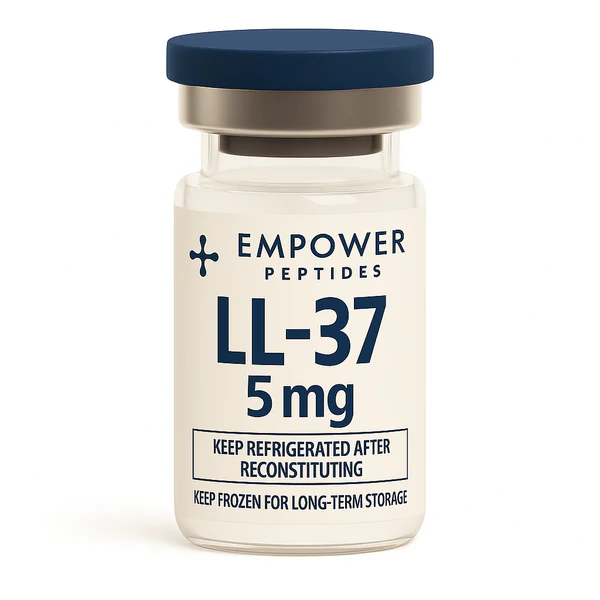
LL-37 – Research Peptide (10mg)
LL-37 is a synthetic peptide fragment frequently examined in controlled laboratory environments for its involvement in innate immune signaling pathways and cellular response modeling. Researchers utilize this peptide to explore mechanisms related to epithelial integrity, host–pathway interactions, and biochemical signaling frameworks.
📌 Product Specifications
- Form: Lyophilized Powder
- Amount: 10mg per vial
- Purity: ≥ 98%
- Appearance: White to off-white powder
- Storage: Refrigerate after reconstitution; freeze for long-term storage
🧪 Molecular Information
- Molecular Formula: C179H291N51O51
- Molecular Weight: 4493.27 g/mol
- CAS Number: 219685-51-7
🔬 Research Applications
- Innate immune pathway modeling
- Epithelial and dermal cellular interaction studies
- Inflammatory signaling and biochemical response investigations
LL-37 – Recovery and Repair Peptide FAQ
This FAQ provides structured technical information regarding the immune pathway modeling, molecular specifications, and laboratory handling of LL-37 in controlled research environments.
1. What is LL-37 used for in laboratory research?
LL-37 is used in controlled research environments to study innate immune signaling and cellular response mechanisms. It is commonly applied in experimental models examining how cells communicate and respond to biological stress signals in non-clinical systems.
2. Why do researchers study LL-37 in immune pathway models?
Researchers investigate LL-37 because it is associated with innate immune system signaling processes. It is used to model inflammatory response pathways and study how cellular systems regulate immune-related biochemical activity under controlled laboratory conditions.
3. What form and quality standard is LL-37 supplied in?
LL-37 is supplied as a lyophilized powder in 10mg vials with a purity level of ≥ 98%. It appears as a white to off-white powder, designed for consistent handling and reproducible use in structured laboratory research workflows.
4. How should LL-37 be stored for research stability?
For optimal stability, LL-37 should be refrigerated after reconstitution. For long-term storage, freezing is recommended to help preserve peptide integrity and maintain consistent performance during ongoing laboratory experiments.
5. What molecular identifiers are associated with LL-37?
LL-37 is identified by CAS Number 219685-51-7, with a molecular formula of C179H291N51O51 and a molecular weight of 4493.27 g/mol. These identifiers support accurate documentation, compound verification, and standardized use in laboratory research studies.
| Weight | 0.1 oz |
|---|
Refer friends. Earn together
Invite your friends and earn a discount on your next purchase. Your friend also earns a discount! Get started now, by sharing your referral link with your friends.
Refer friends. Earn together
Invite your friends and earn a discount on your next purchase. Your friend also earns a discount! Get started now, by sharing your referral link with your friends.
Related products
-
Recovery and Repair Peptides
BPC-157 – Recovery and Repair Peptide
Price range: $36.00 through $78.00 Select options This product has multiple variants. The options may be chosen on the product page -
Amino Acids and Lipotropic Compounds
AOD9604 – Amino Acid and Lipotropic Compound
Price range: $41.00 through $54.00 Select options This product has multiple variants. The options may be chosen on the product page