


IGF-1 LR3 Growth and Performance Peptide
$55.00
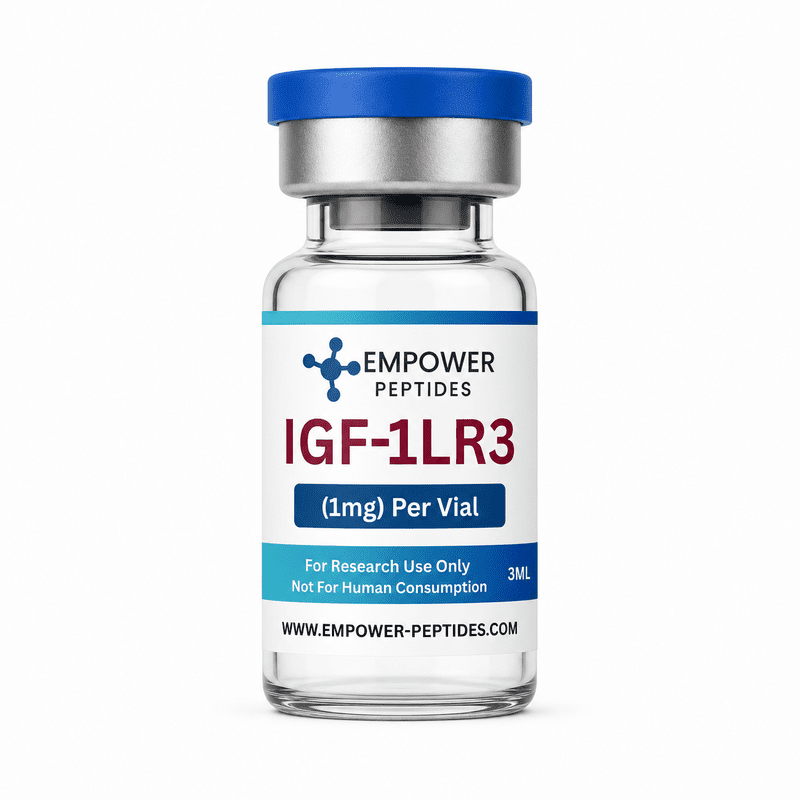
🔬 IGF-1 LR3 – Research Peptide (1mg)
IGF-1 LR3 (Insulin-Like Growth Factor-1 Long Arg3) is a modified analog of IGF-1 studied in controlled laboratory settings for its interaction with cellular signaling pathways, receptor-binding dynamics, and peptide-mediated response mechanisms. Researchers utilize this peptide in experimental models investigating cellular signaling pathways, receptor-binding dynamics, and peptide-mediated response mechanisms.
Lyophilized powder supplied in standard laboratory vials.
Not for injection. Not for clinical, therapeutic, or diagnostic use.
🔹 Product Specifications
- Form: Lyophilized Powder
- Amount: 1mg per vial
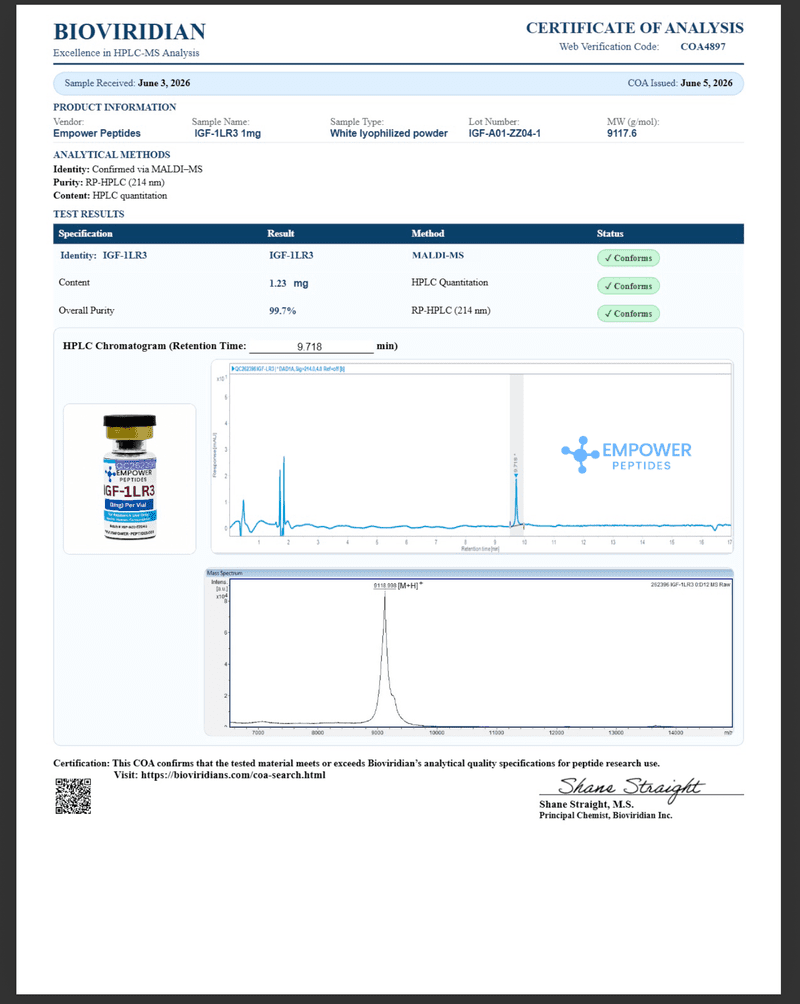
- Purity: ≥ 98%
- Appearance: White to off-white powder
- Storage: Store in a cool, dry environment. Refrigerate after reconstitution.
🧪 Molecular Information
- Molecular Formula: C400H625N111O115S7
- Molecular Weight: ~9111.0 g/mol
- Structure: Recombinant analog of IGF-1 with Arg substitution at position 3 and extended peptide chain
🔬 Research Applications
- Cellular signaling pathway research
- Receptor-binding interaction studies
- Intracellular signaling cascade modeling
- Modified IGF analog behavior in controlled laboratory environments
💡 Interested in the Science?
Explore how modified IGF analogs like IGF-1 LR3 are evaluated in laboratory research involving receptor-binding dynamics, intracellular signaling pathways, and peptide-mediated cellular response models.
🔬 IGF-1 LR3 – Frequently Asked Questions (Research Use Only)
The following FAQs are intended for qualified researchers and laboratory professionals seeking scientific information about IGF-1 LR3 peptide. All content is provided for informational purposes only and does not constitute medical, clinical, or therapeutic advice.
Q: What is IGF-1 LR3 peptide?
IGF-1 LR3 (Insulin-Like Growth Factor-1 Long Arg3) is a recombinant analog of IGF-1 featuring an arginine substitution at position 3 and an extended amino acid sequence. It is investigated in laboratory research involving receptor-binding dynamics, intracellular signaling pathways, and peptide-mediated cellular response models. Supplied as a research-use-only lyophilized powder, IGF-1 LR3 is not intended for clinical, therapeutic, or diagnostic use.
Q: What are the primary research applications of IGF-1 LR3?
In controlled laboratory environments, IGF-1 LR3 is utilized in studies involving receptor-binding interactions, intracellular signaling pathways, peptide stability analysis, and cellular response modeling. It is supplied exclusively as a research-use-only material and is not intended for clinical, therapeutic, or diagnostic applications.
Q: How should IGF-1 LR3 lyophilized powder be stored in a laboratory setting?
IGF-1 LR3 should be stored in a cool, dry environment away from moisture, light, and temperature fluctuations. Lyophilized powder maintains stability under refrigerated conditions. Once reconstituted, the solution should be refrigerated and handled according to appropriate laboratory procedures. Repeated freeze-thaw cycles should be avoided to maintain compound integrity.
Q: Is IGF-1 LR3 approved for human use or clinical applications?
No. IGF-1 LR3 is classified strictly as a research-use-only (RUO) laboratory material. It has not been approved by any regulatory authority for human therapeutic, diagnostic, or clinical use. It is intended solely for controlled laboratory research conducted by qualified scientific personnel.
Q: What analytical methods verify IGF-1 LR3 peptide purity?
Research-grade IGF-1 LR3 purity is verified using High-Performance Liquid Chromatography (HPLC) and mass spectrometry (MS) to validate molecular weight and structural integrity. These analytical methods support consistency for laboratory research. A Certificate of Analysis (COA) is provided to support batch verification.
| Weight | 0.2 oz |
|---|---|
| Strenght |
Refer friends. Earn together
Invite your friends and earn a discount on your next purchase. Your friend also earns a discount! Get started now, by sharing your referral link with your friends.
Refer friends. Earn together
Invite your friends and earn a discount on your next purchase. Your friend also earns a discount! Get started now, by sharing your referral link with your friends.
Related products
- Cognitive and Longevity Peptides
Tesofensine 500mcg Tablets (100 Count)
Original price was: $180.00.$115.00Current price is: $115.00. Add to cart - Growth and Performance Peptides
CJC-1295 – Growth and Performance Peptide
Price range: $50.00 through $64.00 Select options This product has multiple variants. The options may be chosen on the product page

